Technical Resources
Introduction to Centralized Lubrication and Oil Supply Systems
What is a centralized lubrication supply system?
A centralized lubrication system supplies moving or rotating machine components with the right quantity of lubricant at the right time. Lubricant travels from the supply unit through tubing to one or more lubrication points at set intervals.
A centralized lubrication system includes lubricators, Oil line, filters and distributors and other components. Monitoring devices such as pressure gauges, Pressure Switch, float switches and related monitoring devices, together with tube clamps and fittingsThese piping components form a complete lubrication system.
Benefits of lubrication management.
Oil and grease are commonly used lubricants in lubrication systems,Differences Between Oil and Grease Lubrication Systems, and lubricants serve the following functions in different applications:
1. Reduce friction and wear to extend machinery service life.
2. Reduce energy consumption and increase production profitability.
3. Improve heat dissipation and limit temperature rise caused by friction between machinery and workpieces.
4. Sealing, dust protection and rust prevention help isolate moisture, oxygen and harmful media in the air.
5. Lubricant circulation carries contaminants away for removal by a filter.
Proper lubrication management is essential for machinery to operate smoothly and continuously. Key points are as follows:
1. Right lubricant: select a lubricant of the appropriate specification.
2. Timeliness: lubricate, inspect and change oil at the specified intervals.
3. Right amount: apply the appropriate quantity of lubricant.
4. Right place: apply lubricant to the parts that require lubrication.
5. Right person: designate personnel to lubricate, change oil and inspect.
Proper management of these items improves machinery performance and provides the following benefits:
1. Reduce friction and save power.
2. Reduce wear and extend machinery service life.
3. Reduce machinery failure rates and improve production efficiency.
4. Save lubricant.
5. Reduce machinery maintenance costs and increase production profitability.
How do you select the right lubrication system?
Use the following 8 criteria to select a suitable lubricator model and specification, then select matching distributors and piping components:
1.What lubricant type and viscosity will be used? (Oil / grease.)
2.Does the lubrication point require a precise oil quantity? (Yes: metered supply / No: non-metered supply.)
3.How is the lubricator controlled? (PLC / timer / continuous operation.)
4.What operating pressure does the lubricator require?
5.How many lubrication points does one lubricator serve?
6.How much oil do all lubrication points require in total per minute?
7.What is the line length to each lubrication point?
8.What monitoring equipment is required? (Float switch / pressure switch / pressure gauge)
CHEN YING manufactures a range of oil- and grease-lubrication products, each with different features and benefits. Use the table below to select the right product:Differences Between Resistance-type and Pressure-relief Lubrication Systems
Lubrication system lubricant type. | Lubrication point oil-volume type. | Lubricator type. | Compatible distributor. |
Oil Lubrication System | Non-metered lubrication. | Straight-through distributors and proportional fittings. | |
Straight-through distributors and proportional fittings. | |||
Oil-mist spray guns and proportional fittings. | |||
Metered lubrication | positive-displacement distributors | ||
Oil-air distributors and oil-air spray guns. | |||
OE, OG, OQ, OT Spray Guns | |||
Grease Lubrication System | Non-metered lubrication. | Straight-through distributors, proportional/Metering Fittings | |
Metered lubrication | positive-displacement distributors | ||
OT Spray Guns |
◆ For precise oil delivery at each lubrication point, select a metered-output lubricator and use it with positive-displacement distributors. Positive-displacement distributors offer the following advantages:
Each distributor outlet operates independently, so a blockage in one outlet line does not affect the others.
Precise discharge delivers a metered quantity of lubricant to each lubrication point.
Discharge is unaffected by line length, allowing simultaneous lubrication.
Various discharge volumes are available for flexible combinations.
◆ When continuous oil delivery is required, avoid lubricators with motor thermal protection: these units stop temporarily when the motor temperature reaches100 oC, for approximately five minutes.
◆ In addition to oil and grease lubricators, equipment is available for cutting fluid COM pneumatic oil-mist lubricator is available as an option.
How do you select a suitable lubricator based on the total oil required by the lubrication points?
Lubricating-oil requirements are generally determined from experience and actual measurements. Formulas are available for different machines, but requirements depend on many factors: friction-surface materials and roughness; speed, load and ambient temperature; lubricant type; and sealing conditions. Calculated values are therefore not definitive, and the oil quantity must be adjusted to the actual operating conditions.
Generally, select a lubricator according to the total oil demand of the lubrication points, then select suitable piping components for the lubricator.
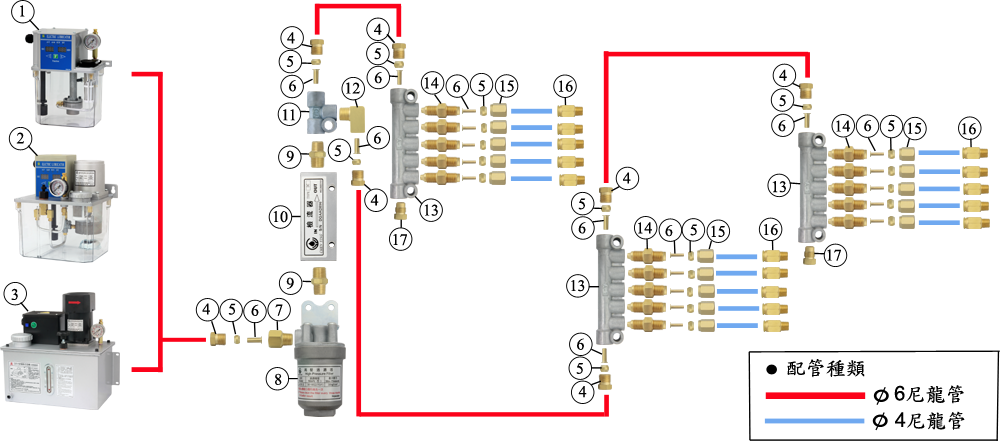
The diagram below shows a resistance-type oil-lubrication system supplying 15 lubrication points from one lubricator. For a total demand of 130cc/min, select CEN02; for 250cc/min, select CENA-25W; for 500cc/min, select CEV-60W.
No | Product name | No | Product name | No | Product name | No | Product name |
1 | CEN02lubricators | 6 | Inner-diameter shaft. | 11 | Tee Fitting | 16 | Push-in Straight Connector |
2 | CENA-25W lubricators | 7 | Straight fitting. | 12 | Right-angle fitting. | 17 | External Hexagon Plug |
3 | CEV-60W lubricators | 8 | filters | 13 | A-7distributors | ||
4 | Sleeve Cap | 9 | Male-threaded Hexagon Nipple | 14 | RC Metering Fittings | ||
5 | Sleeve | 10 | Magnetic reed flow detector. | 15 | Nut |
How do you select a suitable tank for a lubricator?
CHEN YING offers various reservoirs. The following table groups them by capacity and material:
Tank Capacity | 1L | 2L | 2L | 3L | 4L | 4L | 8L | 12L and above |
Tank Material | Resin | Resin | Aluminum alloy | Resin | Resin | Aluminum alloy | Sheet metal | Sheet metal |
In general, replace the oil in the lubricator reservoir at least once every three months to prevent lubricant deterioration from damaging machine components or metal products.
The diagram below shows the piping of a pressure-release oil lubrication system, with one lubricator supplying oil to 15 lubrication points.

| X-axis T-500 | Lubrication point. | 1 | 2 | 3 | 4 | 5 | Total X-axis flow |
| Flow rate | 0.5cc | 0.5cc | 0.5cc | 0.1cc | 0.1cc | 1.7cc | |
Y-axis T-500 | Lubrication point. | 1 | 2 | 3 | 4 | 5 | Total Y-axis flow |
| Flow rate | 0.2cc | 0.2cc | 0.2cc | 0.3cc | 0.3cc | 1.2cc | |
Z-axis T-500 | Lubrication point. | 1 | 2 | 3 | 4 | 5 | Total Z-axis flow |
| Flow rate | 0.5cc | 0.5cc | 0.5cc | 0.3cc | 0.3cc | 2.1cc |
The 15 lubrication points consume a total of 5cc each time the lubricator operates (1.7cc + 1.2cc + 2.1cc = 5cc). If the CEN03 lubricator operates every 4 hours, it runs 6 times daily (24 hours / 4 hours = 6), requiring 30cc of lubricating oil per day (5cc × 6 = 30cc). Over 3 months, total consumption is 2.7L (30cc × 90 days = 2.7L). A 3L tank is therefore recommended for the CEN03.
Latest News
- 2026-09-22 11:27:52
Recommended: Kytola SLM Smart Seal Water Flow Meter with 4–20 mA Output
- 2026-09-22 11:24:14
Variable area flow meters with 4-20 mA signal
- 2026-09-22 11:17:50
Let’s make your flow measurement Kytola Smart
- 2026-08-05 11:08:59
Kytola Gas Flow Conversion Formula
- 2026-08-05 11:03:07
Flow Meter Accuracy — Kytola, Finland
- 2026-08-05 11:01:20
How to Read a Kytola Variable Area Flow Meter